.png)
.png)

September 4, 2026
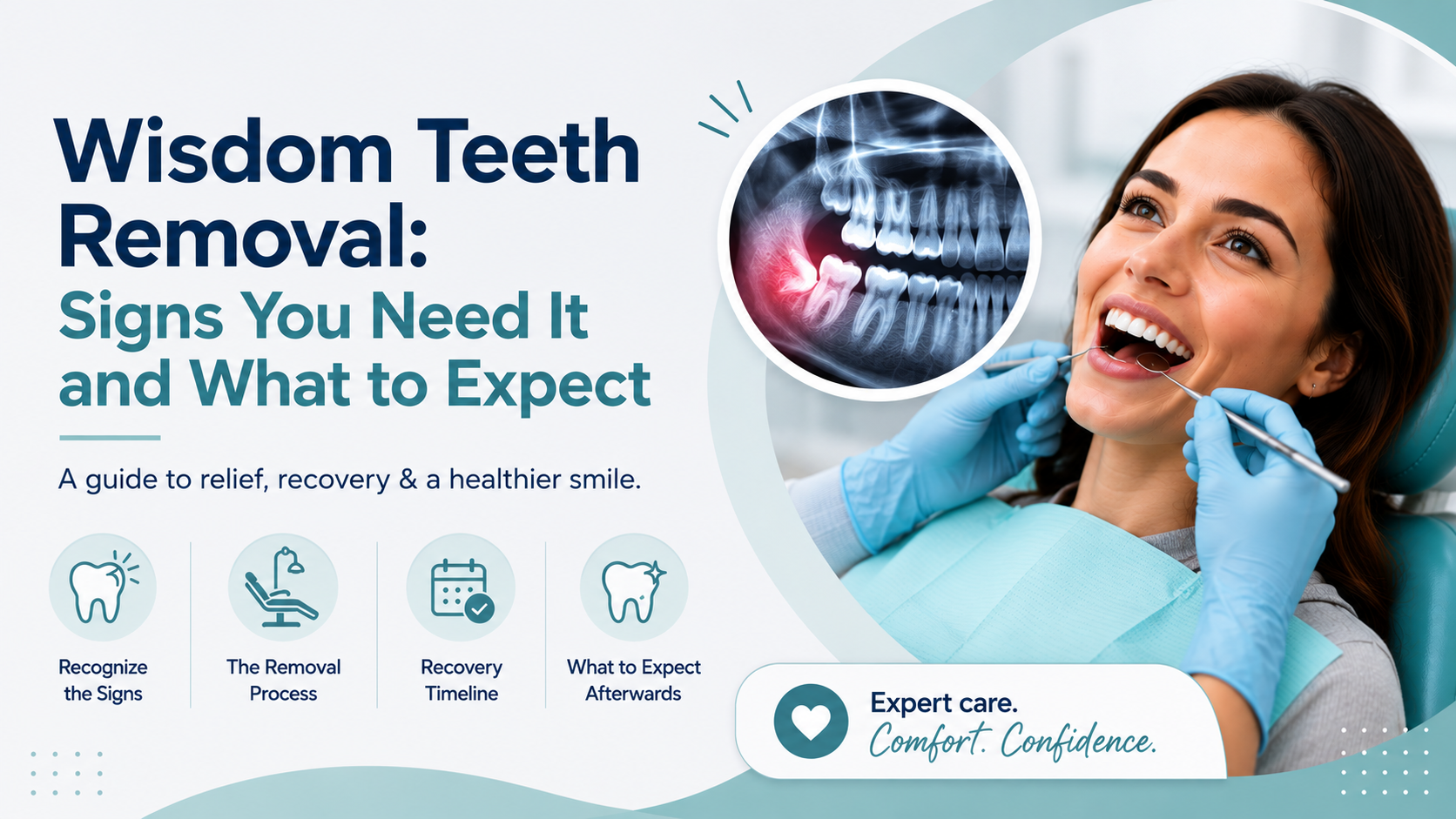
Wisdom Teeth Removal: Signs You Need It and What to Expect
Learn the warning signs of problem wisdom teeth and what happens during removal at our Bentley clinic.


Learn the warning signs of problem wisdom teeth and what happens during removal at our Bentley clinic.
Wisdom teeth — the third molars that usually appear between the ages of 17 and 25 — don't always cause problems, but for a lot of people they do. If you've been getting a dull ache at the back of your jaw, or you've simply been told at a check-up that your wisdom teeth are worth monitoring, it helps to know what's normal, what's not, and what removal actually involves.
Not every wisdom tooth needs to come out, but a few signs are worth acting on rather than waiting through:
Wisdom teeth often become "impacted" — meaning there isn't enough room in the jaw for them to come through properly, so they emerge at an angle, only partially, or not at all. Impacted wisdom teeth are more likely to cause pain, infection, or damage to neighbouring teeth, which is usually the trigger for recommending removal.
If a wisdom tooth has fully erupted, sits in a good position, and you can clean around it properly, it may not need to be removed at all. The decision usually comes down to whether the tooth is causing — or is likely to cause — problems like decay, gum infection, or crowding that's harder to treat the longer it's left. An X-ray is the most reliable way to see how your wisdom teeth are positioned beneath the gum line before any decision is made.
The process typically starts with an assessment and imaging so your dentist can see the exact position and angle of the tooth. On the day of removal, the area is numbed with local anaesthetic, and in some cases sedation can be used for patients who feel anxious about the procedure. The tooth is then carefully removed, and in cases where it's still fully or partially under the gum, a small incision may be needed to access it.
Most straightforward extractions are completed within the same appointment. Afterwards, you'll be given clear aftercare instructions covering what to eat, how to manage swelling, and how to keep the area clean while it heals.
Some swelling, mild discomfort, and jaw stiffness in the first few days is normal and generally manageable with over-the-counter pain relief as advised by your dentist. Sticking to soft foods, avoiding using a straw (which can dislodge the healing blood clot), and gently rinsing with warm salt water after the first 24 hours all support a smoother recovery. Most people are back to normal activities within a few days, though full healing of the gum tissue takes a couple of weeks.
If you're in Bentley or nearby — Wilson, Cannington, Riverton, Como, or the Curtin University area — and you've been putting off a wisdom tooth concern, a proper assessment is the best next step. Our team offers same-day appointments where needed, so a nagging ache doesn't have to wait until it becomes a bigger problem.
Contact us today or book online to have your wisdom teeth assessed by our team at Shop FS6B, 1140 Albany Hwy, Bentley WA 6102.