.png)
.png)

September 15, 2026
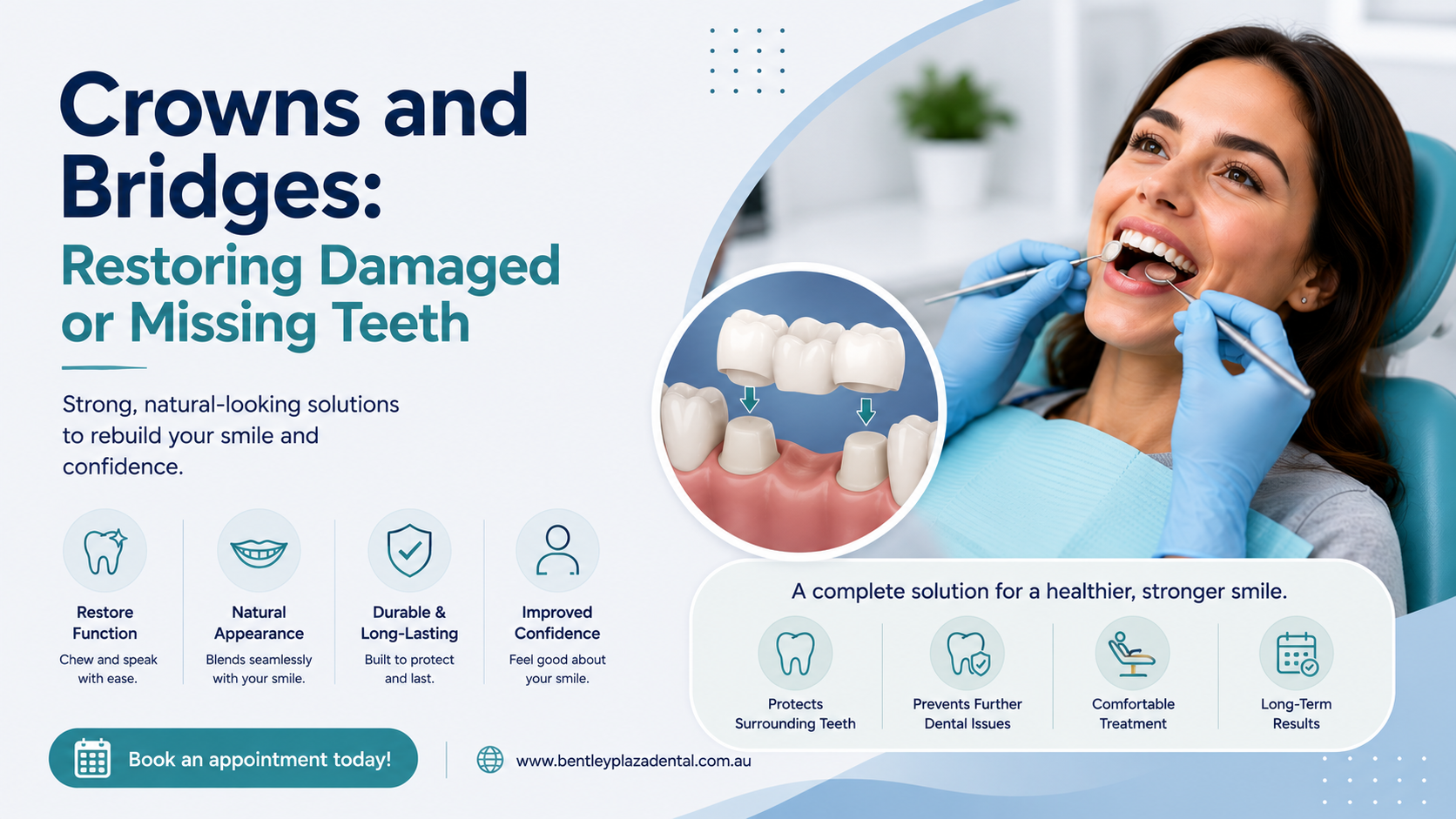
Crowns and Bridges: Restoring Damaged or Missing Teeth
Discover how crowns and bridges repair damaged teeth and replace gaps in your smile.


Discover how crowns and bridges repair damaged teeth and replace gaps in your smile.
Whether a tooth has been weakened by decay, cracked, or is missing altogether, crowns and bridges are two of the most established solutions in restorative dentistry — and understanding the difference between them helps you have a more informed conversation at your next appointment.
A dental crown is a tooth-shaped "cap" that's placed over an existing tooth to restore its shape, strength, and appearance. Crowns are typically recommended when a tooth has been significantly weakened — by a large filling, a crack, or extensive decay — to the point where a regular filling wouldn't provide enough support. Once fitted, a crown functions like a natural tooth for biting and chewing.
A bridge is used to replace one or more missing teeth by anchoring a replacement tooth (or teeth) to the natural teeth on either side of the gap, often using crowns on those adjacent teeth as support. Bridges are a well-established way to close a gap in your smile without the surgical component involved in an implant.
These three options solve different problems. A crown protects and restores a tooth that's still present but compromised. A bridge or an implant both replace a tooth that's already missing — a bridge relies on neighbouring teeth for support, while an implant is anchored directly into the jawbone and doesn't involve altering adjacent teeth at all. Which is right for you depends on the condition of your remaining teeth, your bone health, and your own preference, and it's a conversation worth having directly with your dentist rather than assuming one option is universally "better."
Both crowns and bridges typically involve preparing the relevant tooth or teeth, taking an impression (or digital scan) to ensure an accurate fit, and fitting a temporary restoration while your permanent crown or bridge is custom-made. Once ready, it's checked for fit and bite before being permanently secured.
Crowns and bridges are durable, but they still rely on good oral hygiene to last — brushing and flossing around them (including under a bridge, where a special floss threader can help) prevents decay from developing at the margins where the restoration meets your natural tooth.
If you have a damaged tooth or a gap you'd like addressed, our team can talk you through whether a crown, bridge, or implant is the right fit for your situation. Visit us at Shop FS6B, 1140 Albany Hwy, Bentley WA 6102, or contact us today to book a consultation.