The main types of dental implants are single, multiple, and full-arch, grouped by how many teeth they replace. Your dentist examines your mouth and reviews your medical history to assess which treatment may suit you.
This guide explains each type, what it involves, and its limits, with guide prices for treatment at Bentley Plaza Dental Clinic in Bentley, Perth. For an overview of the service, see our page on dental implants in Perth.
How Are Types of Dental Implants Grouped?
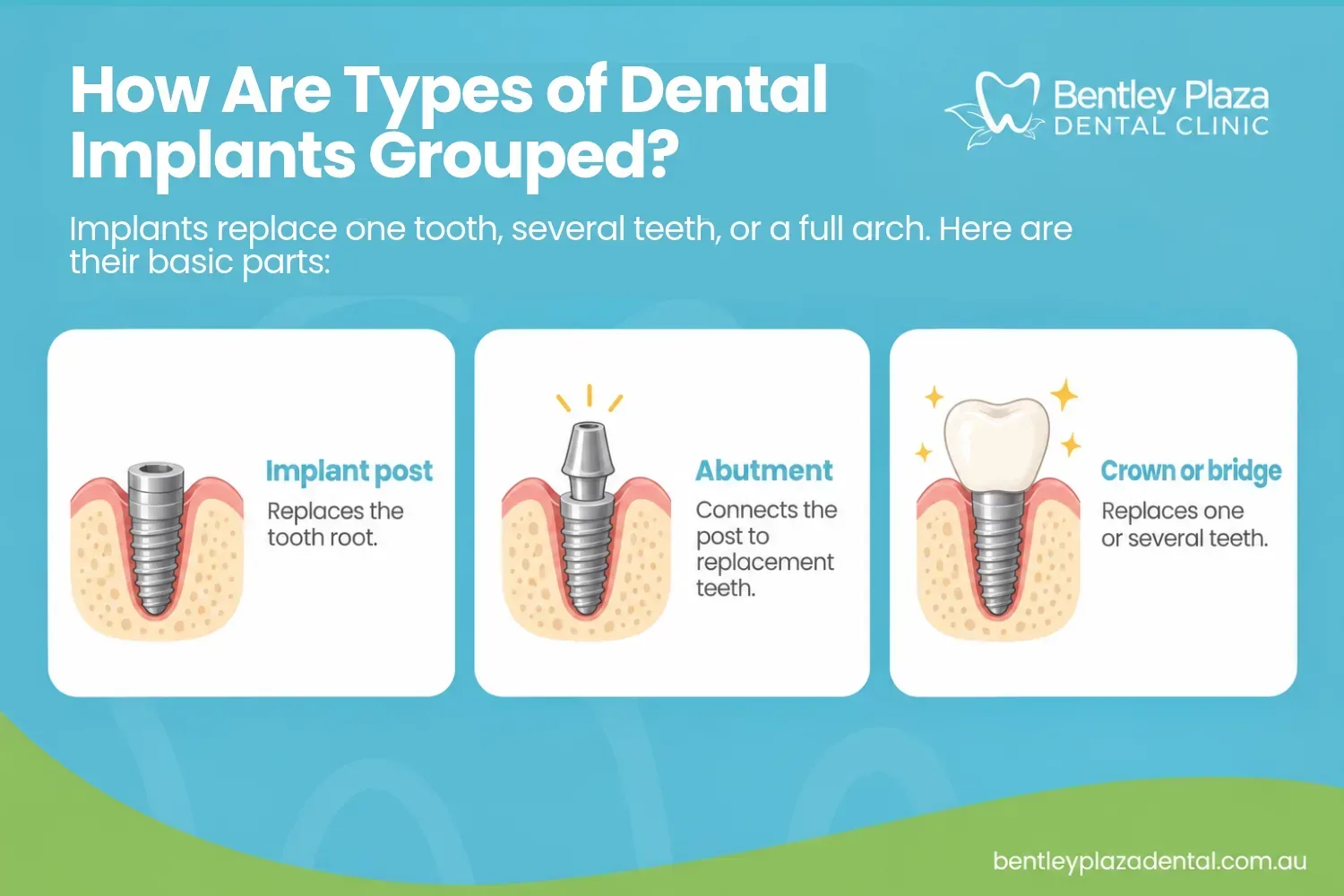
Dental implants are grouped by how many teeth they replace: one tooth (single), several teeth (multiple), or a whole row of teeth in one jaw (full-arch). That row of teeth is called an arch.
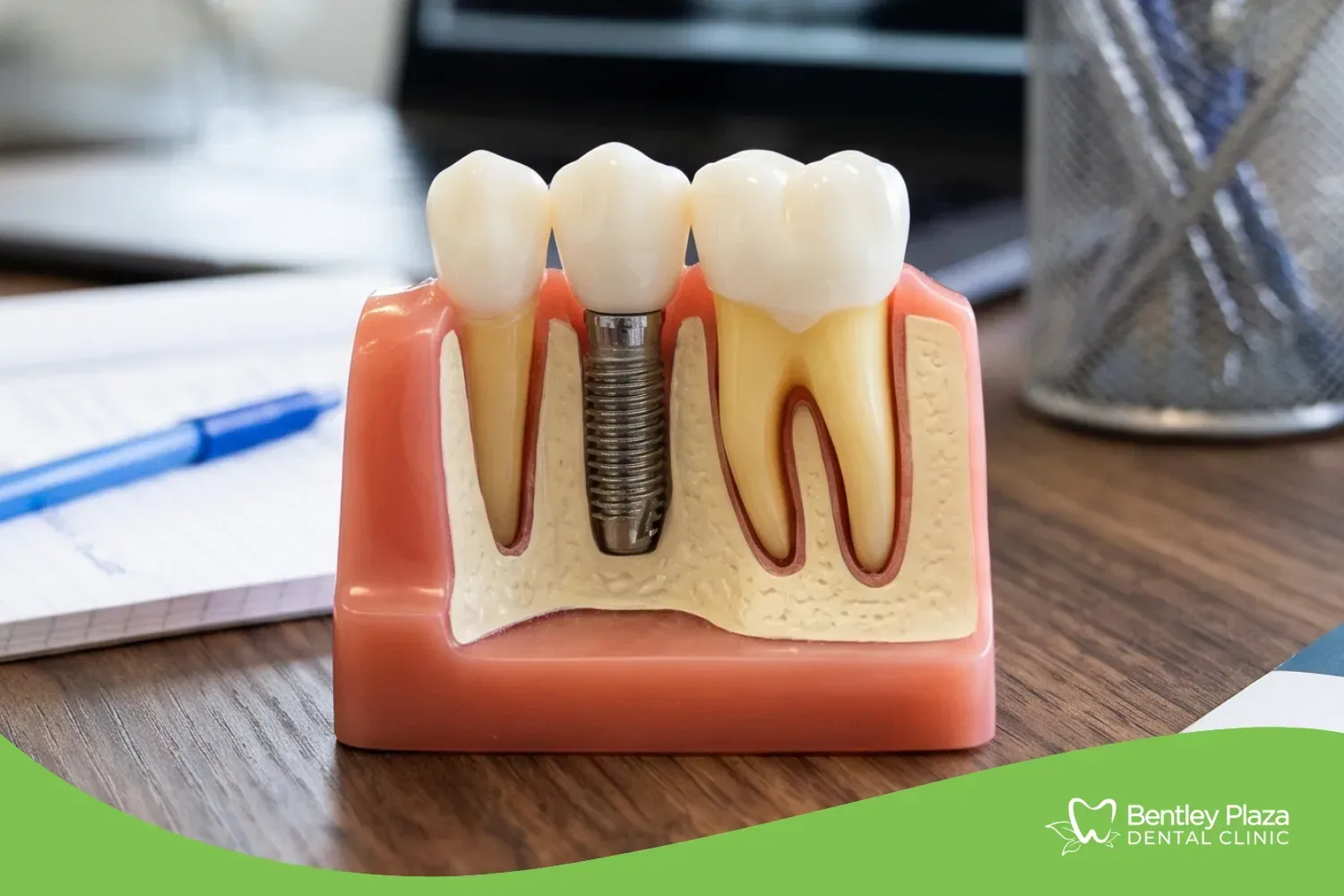
The types of dental implants differ in how many implants are used and what they support, but the basic parts are the same:
Implant post: A screw that replaces the tooth root in your jawbone, usually made of titanium, although some posts are made of zirconia. It is also called a fixture.
Abutment: The connector that joins the replacement tooth or teeth to the post.
Crown or bridge: The visible replacement teeth above the gum. A crown replaces one tooth, and a bridge replaces several.
While you heal, your jawbone bonds with the post in a process called osseointegration. Your dentist checks that bond before fitting the replacement teeth.
Which Dental Implant Replaces a Single Missing Tooth?
A single tooth implant replaces one missing tooth with a post, an abutment, and a crown. Your dentist plans the implant around the size of the gap, the bone beneath it, and the condition of the teeth beside it.
A tooth-supported bridge is attached to the teeth on either side of the gap, which can mean those teeth need to be reshaped first. An implant is placed in the jawbone and stands on its own, so the neighbouring teeth don’t need to be reshaped. An implant may not suit someone who can’t have surgery or can’t keep up the cleaning it needs, and a bridge or denture may be an alternative.
What If You Are Missing Several Teeth in a Row?
An implant bridge replaces several missing teeth in a row with a set of joined replacement teeth that are fixed to implants. It needs fewer implants than teeth. For example, a three-tooth bridge can sit on two implants, one at each end, with the middle replacement tooth held between them.
Because the teeth are joined as one piece, cleaning needs extra care beneath the bridge and around the implants. Your dentist can show you how, so ask before choosing this option. If you have gaps in separate parts of your mouth, each gap is assessed and planned on its own.
What Are Your Options for a Full Arch of Teeth?
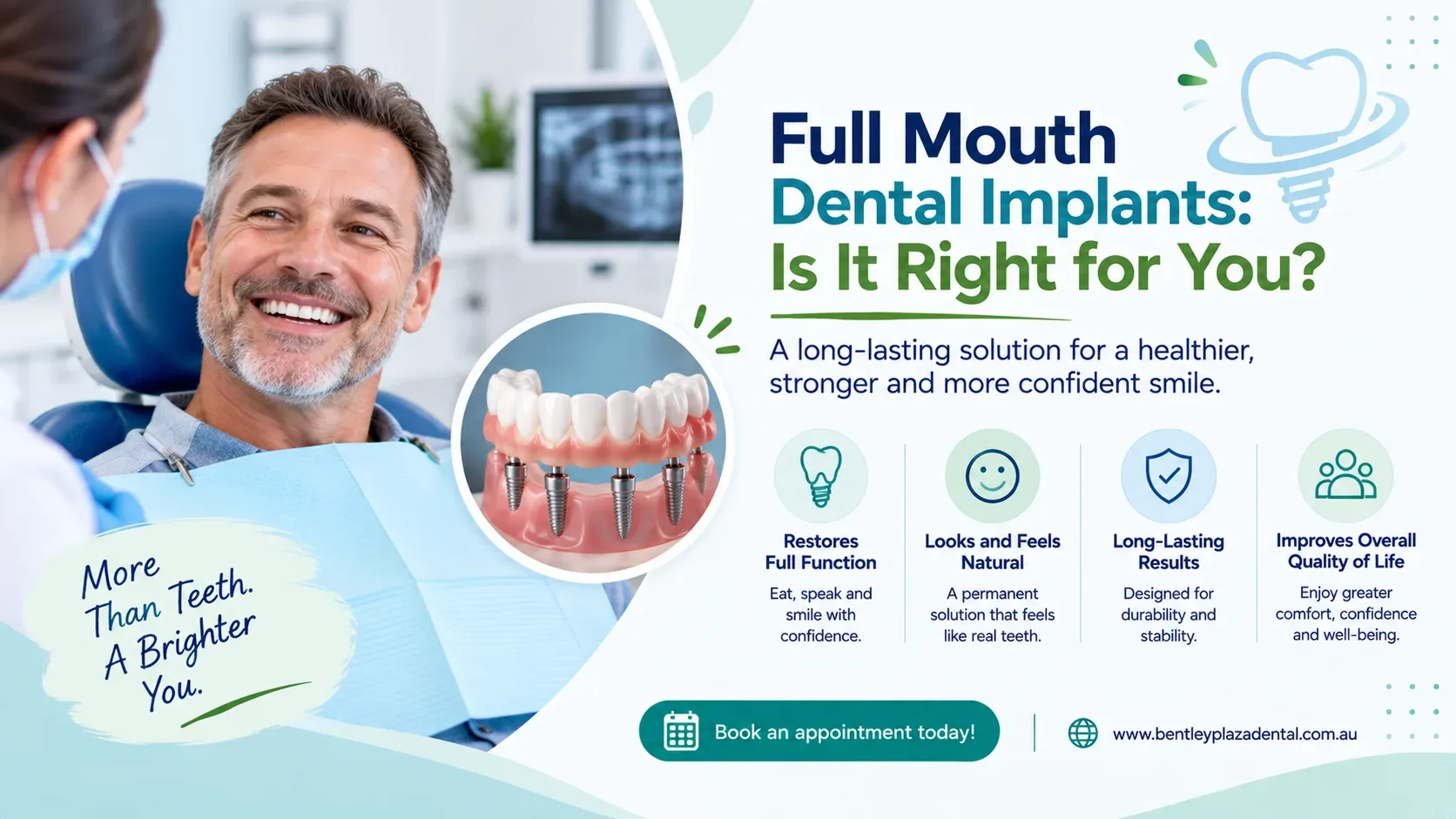
For a full arch, implants can support either a fixed bridge, which stays in place, or a denture that clips on and comes out for cleaning. A denture is a set of replacement teeth made to fit your mouth. Your dentist explains which option suits your jaw and your needs.
All-on-4 fixed bridge
All-on-4 dental implants use four implants in one jaw to support a fixed bridge that replaces the whole arch. The back implants are tilted to make use of the bone that remains, because bone at the back of the jaw often shrinks after tooth loss. If your jaw is too thin, you may need a bone graft first.
Implant-retained denture
An implant-retained denture clips onto the attachments of the implants, so it stays steady during use. You remove it for cleaning, and the implants stay in your jaw.
Fixed bridge on more implants
Instead of four implants, some treatment plans use more to support a fixed bridge across one jaw. Your dentist decides how many implants your plan needs and checks that your jaw has enough bone to hold them.
How Do the Different Types of Dental Implants Compare?
A single implant replaces one tooth, whereas an implant bridge can replace several teeth on fewer implants. For a full arch, an All-on-4 bridge stays fixed, whereas an implant-retained denture comes out for cleaning.
Option
May suit
What is involved
Guide price
Single implant
One missing tooth
One implant with an abutment and crown
From $4,999 per tooth
Implant bridge
Three teeth missing in a row
Two implants and a three-tooth bridge
From $9,000 for 3 teeth
Implant-retained denture
All teeth in one jaw
Implants and a removable denture that clips onto them
From $12,000 per arch
All-on-4
All teeth in one jaw
Four implants and a fixed full-arch bridge
From $25,000 per arch
Disclaimer: These are guide prices for treatment at Bentley Plaza Dental Clinic. Your final price depends on your clinical needs and is confirmed in a written, itemised quote after your consultation. Larger cases cost more, and All-on-4 for both arches starts from $50,000. For pricing details, see our guide to dental implant costs in Perth.
Some people need extra treatment, which is quoted separately: bone grafts from $2,000, sinus lifts from $1,500, and extractions from $199 per tooth. If you choose sedation, the clinic quotes that separately for your case.
Health fund rebates and payment plans (Afterpay and Zip Pay) may apply. Eligibility, fees, and terms apply.
How Do You Know Which Type Suits You?
Your dentist recommends a type of dental implant after assessing your mouth at a consultation. The assessment includes an examination of your teeth, gums, and jawbone, and a review of your medical history.
Not everyone is suitable for implant treatment, even with one or more missing teeth. An implant needs enough healthy bone and gum to hold the post, and some health conditions and habits can slow healing or raise the risk of complications. Some people need extra treatment first, or a different option altogether.
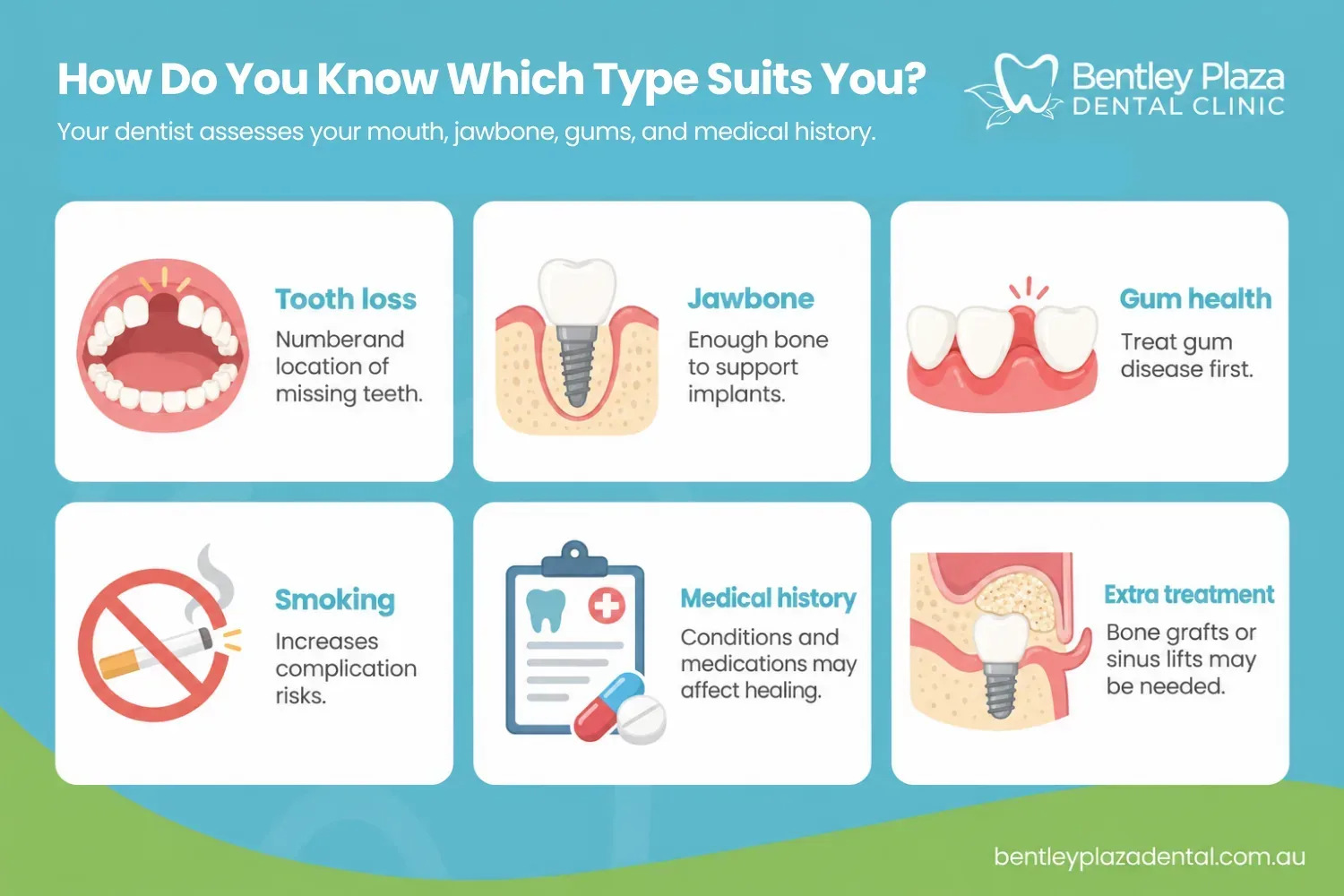
During the assessment, your dentist considers the following factors:
Tooth loss: The position of each gap affects how the replacement teeth can be supported.
Jawbone: The implant sites need enough bone to hold the posts.
Gum health: Gum disease can affect suitability and may need treatment before implant placement.
Smoking: Smoking can increase the risk of implant complications.
Medical history: Tell your dentist about any medical conditions and any medications you take before agreeing to surgery.
Some people need extra treatment to build up the jawbone before an implant can be placed. A bone graft adds bone, or a bone substitute material, where the jaw is too thin to hold an implant. In the upper back jaw, the sinus, which is the air-filled space above your upper back teeth, can sit close to the bone, so a sinus lift raises the sinus lining to make room for a graft beneath it.
Some people still have natural teeth in the area where they want implants. Your dentist assesses the condition of those teeth and explains whether any need to be removed, which is called an extraction. Ask whether any of your natural teeth can be kept. A bridge or denture without implants may suit some people instead.
What Are the Risks of Dental Implants?
Dental implants carry risks during surgery and while the bone heals around each post. Your dentist should explain how those risks apply to you before you consent to treatment.
The risks to discuss with your dentist include the following:
Infection: Infection around an implant can need further treatment.
Bond failure: An implant that doesn't join with the bone may need to be removed.
Nerve injury: Damage to a nerve can affect sensation around the mouth.
Sinus problems: An implant in the upper jaw can affect the sinus above it.
Wear or damage: The replacement teeth can wear, chip, or loosen and may need repair.
Disclaimer: Any surgical or invasive procedure carries risks. Before proceeding, you should seek a second opinion from an appropriately qualified health practitioner.
What Should You Ask Before Choosing a Dental Implant Type?
Before you agree to treatment, ask your dentist why they recommend a particular type, what the alternatives are, and what the treatment will cost in your case. The following questions can help you understand your options:
Treatment choice: Why do you recommend this option for my mouth?
Alternatives: What would a bridge or denture without implants involve?
Preparation: Will I need an extraction or graft before implant placement?
Quote inclusions: Does the written, itemised quote cover scans and the replacement teeth?
Further charges: What costs could arise if the treatment plan changes?
Review visit: When will you check healing, and who should I contact between appointments?
Discuss Your Dental Implant Options
Bentley Plaza Dental Clinic offers dental implants to replace a single tooth, several teeth, or a full arch, including implant bridges, implant-retained dentures, and All-on-4.
At your consultation, we assess your mouth, explain the risks, and discuss alternatives to implants. You then receive a written, itemised quote, so you can review the costs before deciding. We accept most major health funds, and payment plans through Afterpay and Zip Pay may be available, subject to eligibility, fees, and terms.
How long an implant lasts depends on your oral health, your home care, and your check-ups, so your dentist can't give one figure for everyone. The replacement teeth attached to an implant can wear over time and may need repair or replacement. Ask which parts might need maintenance and how your dentist would manage repairs.
Is dental implant treatment painful?
Local anaesthetic is used so that the area is numb during treatment. Some tenderness afterwards is normal, and pain and swelling can occur, with the amount varying between people. Your dentist will discuss what to expect during and after treatment, including the symptoms and pain you may have. Before you leave the clinic, ask what pain relief your dentist recommends, and contact the clinic if you are concerned about symptoms afterwards.
How do I care for my dental implants?
For the first weeks after surgery, follow your dentist’s instructions for cleaning the surgical site rather than your usual routine. Your dentist will tell you when you can go back to normal cleaning. After that, brush twice a day and clean between the implants and your other teeth with floss, interdental brushes, or a water flosser. Your dentist can show you how to clean around fixed replacement teeth.
Does health insurance cover dental implants?
Depending on your policy, a health fund may cover part of the cost of implant treatment. We accept most major health funds and can process your claim on the spot. Your rebate depends on your fund and level of extras covered. Ask your fund about limits and waiting periods before treatment.
Is recovery different for each implant type?
Recovery depends on the surgery involved and how you heal, rather than the implant type alone. If you need a bone graft before implant placement, the procedure and healing can extend your treatment timeline. Ask how your treatment plan affects eating and time away from work.
This article is general information only. It is not a substitute for advice about your own mouth. Talk to your dentist about what suits you.