


Resources
Dental Implants vs. Crowns: Which Option Suits You?
Compare dental implants vs. crowns to see when a crown can protect a damaged tooth and when an implant may suit you if the tooth needs to be removed.
November 26, 2026
Read More
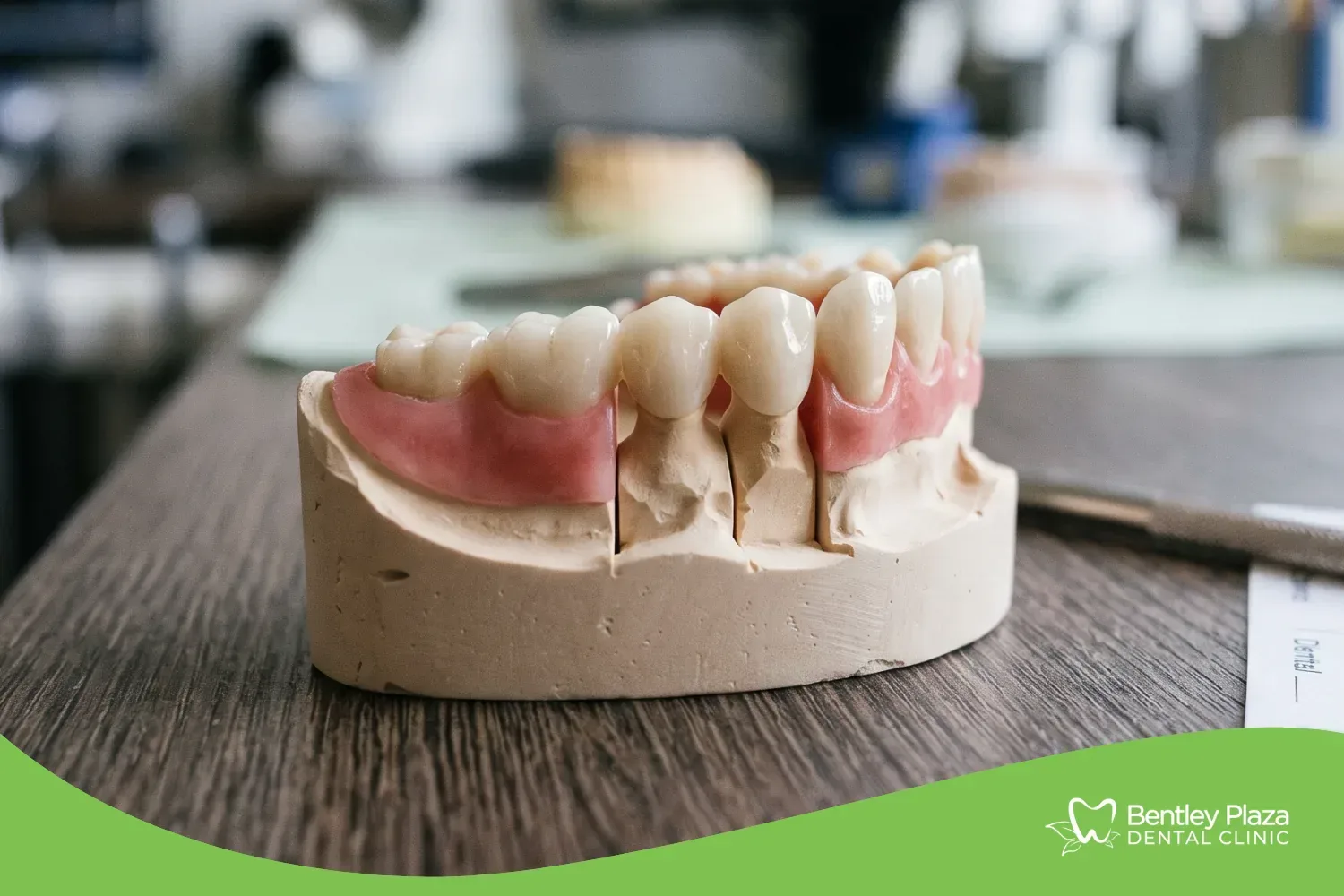
Both a dental bridge and an implant can replace one missing tooth, and the right choice depends on an assessment of your mouth. In a dental bridge vs. implant comparison, a bridge is anchored to the neighbouring teeth, while a single tooth implant is a post in the jawbone that holds a crown, a tooth-shaped cap.
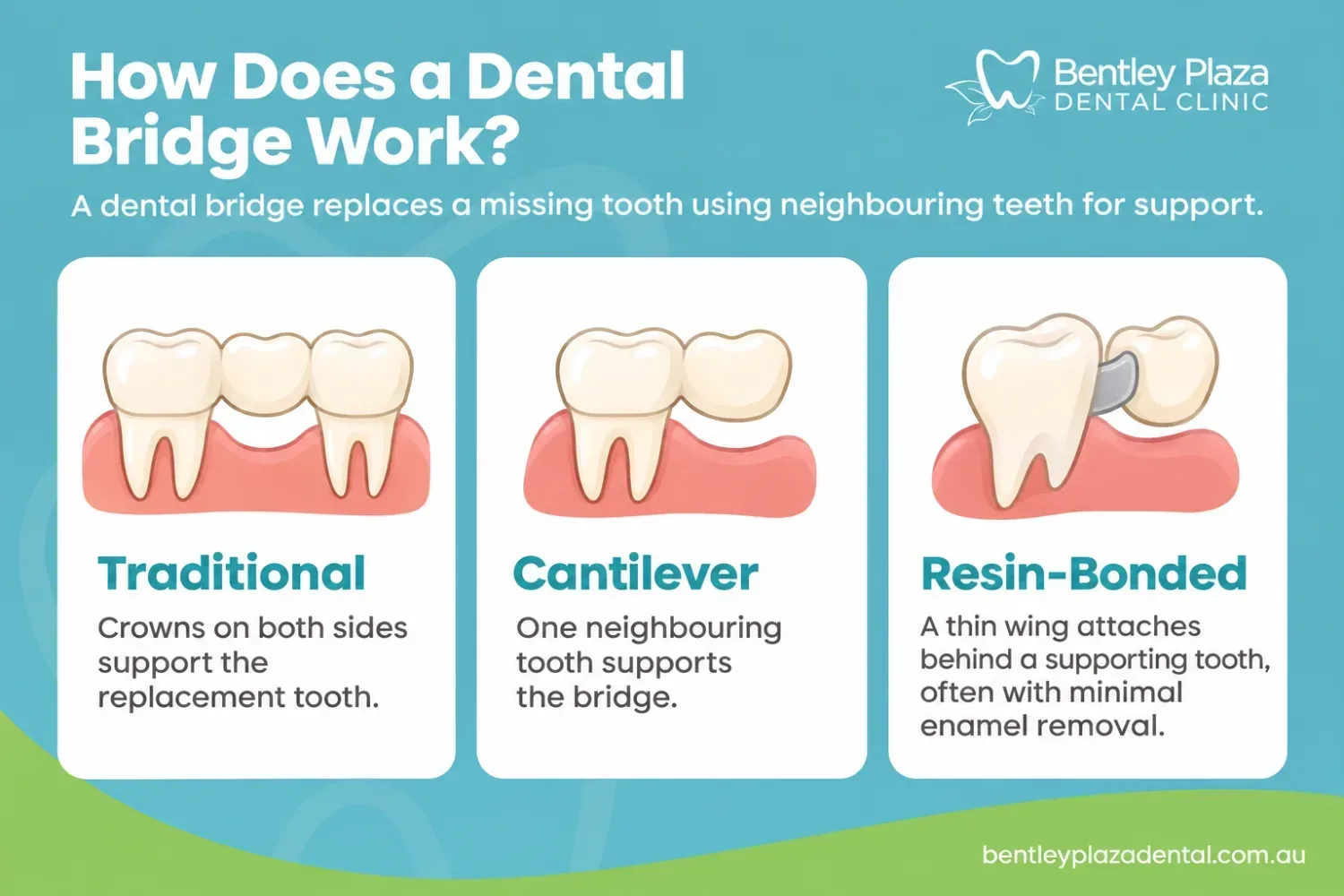
A dental bridge fills the gap with a replacement tooth, called a pontic, and uses the neighbouring teeth, called abutment teeth, to hold it in place. The bridge type determines how many teeth support it and how the dentist attaches it.
Your dentist confirms which design suits your mouth. Read more about crowns and bridges at Bentley Plaza Dental Clinic.
During the implant surgery, a dentist places a post in the jawbone to replace the missing root, and a connector called an abutment joins the post to the crown. Over the following months, bone grows around and attaches to the post, a process called osseointegration, and your dentist checks healing before confirming when to fit the final crown.
Our guide to the dental implant procedure explains each step.
A bridge relies on the neighbouring teeth and avoids surgery, while an implant is placed in the jawbone and leaves the neighbouring teeth untouched. If both options suit your mouth, weigh preserving your neighbouring teeth against how you feel about surgery and healing time.
Table 1: Bridge vs. implant at a glance
| What to compare | Tooth-supported bridge | Single tooth implant |
|---|---|---|
| How it works | The replacement tooth is fixed to one or more teeth beside the gap. | A post in the jawbone supports a crown at the missing tooth site. |
| Effect on neighbouring teeth | A traditional bridge usually needs tooth shaping. With a resin-bonded bridge, the amount of shaping depends on the design. | The neighbouring teeth keep their shape because they don't support the crown. |
| Surgery | No surgery is needed to place a post. The dentist prepares the supporting teeth and fits the bridge. | The dentist places the post in the jawbone during surgery. |
| Number of visits | A traditional bridge usually needs one appointment to prepare the teeth and one to fit the bridge, plus review visits. | Treatment takes several appointments, with healing time between placement and the final crown, plus review visits. |
| Cleaning | Guide floss underneath the replacement tooth with a floss threader and clean around the supporting crowns. | Brush around the gumline and clean between the crown and nearby teeth. |
| Points to consider | The supporting teeth and their gums need to be healthy enough to carry the bridge. | There needs to be enough jawbone to hold the post, and healing affects the treatment schedule. |
The right option depends on what your dentist finds at the gap and whether any dental or medical issues need attention before treatment.
If a neighbouring tooth already has a large filling or crown, your dentist checks how much sound tooth remains beneath the existing dental work. When the teeth beside the gap are intact, ask whether a design that preserves more of the tooth would suit your bite. Your dentist also checks the gums around the proposed supporting teeth for gum disease before recommending treatment.
Not everyone is suitable for an implant. If the jawbone at the gap is too thin to hold the implant post, your dentist may discuss a bone graft, a procedure that adds bone to the area. Your dentist also considers gum health, your medical history, and any medicines you take.
Tell your dentist if you smoke, as smoking can raise the risk of complications after oral surgery. If an implant is unsuitable, ask about a removable partial denture (a plate that holds a replacement tooth) or about leaving the gap.
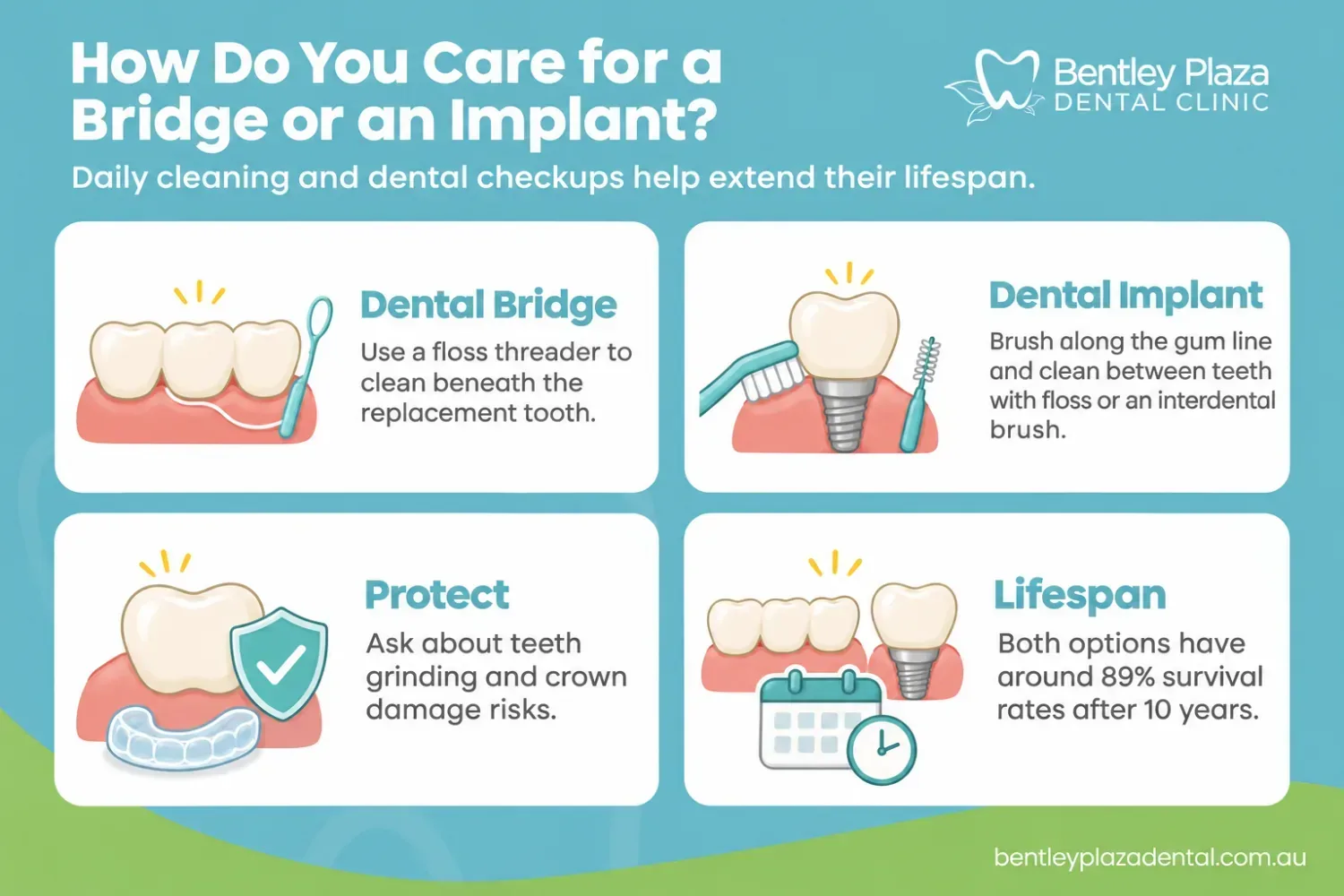
Brush your replacement tooth every day and attend the review visits your dentist recommends so that they can check the health of the surrounding gums. During those visits, your dentist can show you how to clean any areas you may be missing.
To reach the gum line beneath a dental bridge, use a floss threader, a small loop that guides floss under the replacement tooth. Sweep the floss along the gums and clean where each crown meets its supporting tooth to control plaque, the sticky film of bacteria that builds up on teeth.
Once the dental implant has healed, angle your toothbrush towards the gum line where the crown meets the surrounding tissue. Between the crown and its neighbouring teeth, use floss or a small interdental brush that fits comfortably into the space. If you grind your teeth, ask how the extra force could affect the crown, including the risk of chipping.
Studies report that both options often stay in place for many years. A 2007 systematic review in Clinical Oral Implants Research pooled studies with at least five years of follow-up. It found that 93.8% of tooth-supported bridges and 94.5% of implant-supported single crowns were still in place after five years and 89.2% and 89.4%, respectively, after 10 years.
These are averages for how long each option lasts, not a prediction for your tooth, and a bridge or crown that stays in place may still need repair. Cleaning, smoking, and grinding your teeth can also affect how long either option lasts, and your dentist can explain what to expect for your mouth and individual circumstances.
Both options carry risks: a bridge mainly affects the supporting teeth, while an implant involves surgery and healing. Any surgical or invasive procedure carries risks. Before proceeding, you should seek a second opinion from an appropriately qualified health practitioner.
After your dentist shapes a supporting tooth so a crown can fit over it, the tooth may feel sensitive. Over time, if not cleaned properly, decay can develop where the crown meets the tooth, and the surrounding gums can develop disease.
If the soft tissue inside a supporting tooth becomes inflamed or infected, you may need root canal treatment to remove the affected tissue and seal the space. If a supporting tooth becomes too damaged to carry the bridge, you may need treatment for that tooth and a replacement bridge.
Depending on where your dentist places the post, implant surgery can damage nearby teeth or nerves, and placement near a sinus in the upper jaw can cause sinus problems.
The surgical site can become infected during healing, and the implant may not bond with the jawbone, in which case your dentist may need to remove it. Later, a condition called peri-implantitis can inflame the gums and damage the bone supporting the post.
Discuss with your dentist how to take preventative and cautionary measures for your proposed treatment.
The cost depends on the bridge design and number of units, the scans you need, any extraction or bone grafting, and the crown material. Your dentist will give you a written, itemised quote after your consultation.
The bridge design determines how many individual parts, called units, are included in the price. In a traditional bridge for one missing tooth, two supporting crowns and one replacement tooth make up three units. Ask your dentist how many units your proposed bridge needs.
Scans and the choice of crown material can affect the price of an implant. If you need a bone graft or tooth extraction before implant placement, that work can affect the total cost.
Ask your dentist to explain what they found during your assessment and how those findings affect your options for replacing a missing tooth. These questions can help you compare treatment plans and written quotes:
A dental bridge vs. implant decision comes down to the teeth beside the gap, your jawbone and gums, and how you feel about surgery and healing.
Book online or call (08) 9466 3600 to arrange a consultation at Bentley Plaza Dental Clinic in Bentley Plaza Shopping Centre on Albany Highway. We'll assess your mouth and explain what a bridge or single tooth implant treatment involves.
Common questions
When you compare dental implants vs. dental bridges, the discomfort depends on the work you need and how you heal. After implant surgery, you may have soreness and swelling around the implant site, and the teeth prepared for a bridge may feel sensitive. Ask your dentist what to expect during and after each procedure.
A traditional bridge usually requires the dentist to shape the neighbouring teeth, and the enamel removed during shaping doesn't grow back. The teeth that support the bridge can still develop decay if not cleaned properly, and the joined design means you need to clean beneath the replacement tooth.
Implant treatment involves surgery, and healing takes time before the final crown is fitted. Risks include infection, the implant not bonding with the jawbone, and peri-implantitis.
Not always. Some people choose to leave the gap after talking it through with their dentist, particularly if their remaining teeth provide enough support for chewing. Your dentist can check how your teeth meet and discuss whether replacing the tooth would help you chew more comfortably.
In some cases, a dentist can place an implant at the same appointment as the extraction. If the area needs time to heal or additional treatment before it can support the post, your dentist may recommend placing the implant at a later visit.
This article is general information only. It is not a substitute for advice about your own mouth. Talk to your dentist about what suits you.
Back to Top: Dental Bridge vs. Implant for One Missing Tooth
Keep reading